Organisation & Processes
“Your Path to Operational Excellence”
- Process Cost Analysis: Identifying savings potential to sustainably enhance profitability.
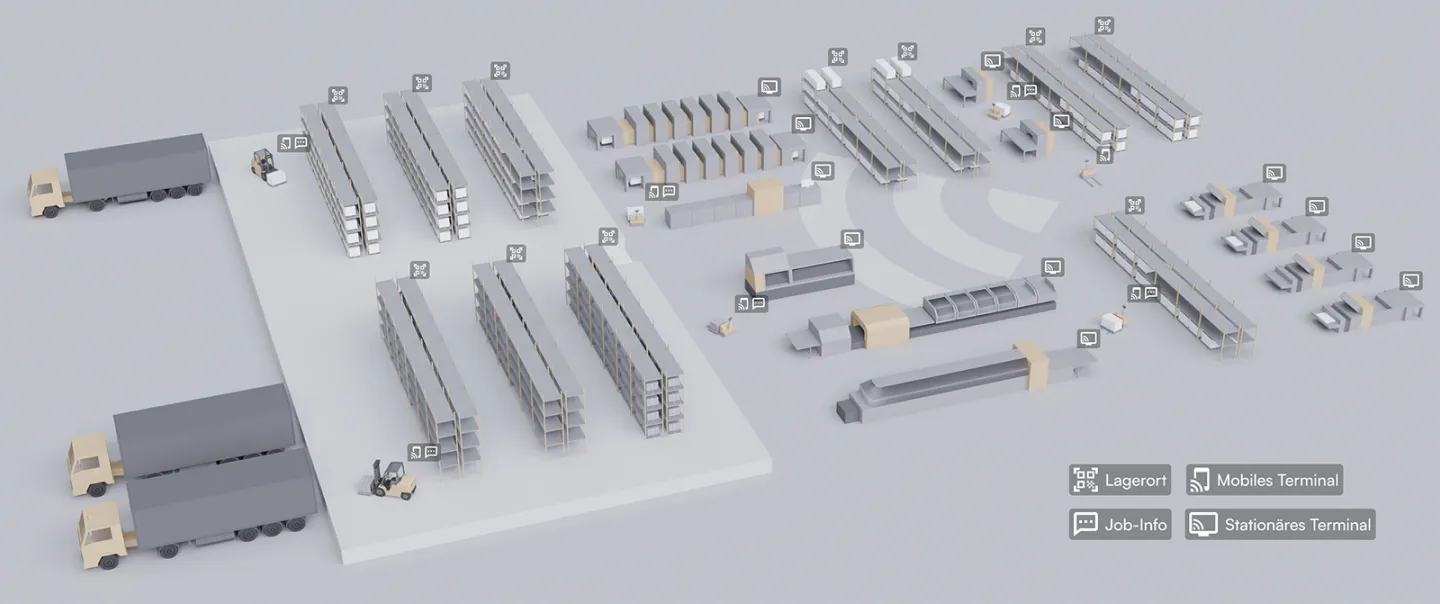
- Integrated Print Factory: Digitizing business and production workflows while optimizing supply chains.
- Artificial Intelligence: Empowering your organization to continuously learn and improve.
- Organizational Consulting: Strengthening agility, flexibility, and innovation capability. Increasing departmental productivity.
With our deep expertise in digital transformation, efficient business processes, supply chain optimization, and the implementation of innovative technologies, we actively support companies on their journey toward the connected print factory. We help leaders unlock their full potential, optimize processes, and position their organizations for long-term success.
...mehr
Step 1: Systematically analyze.
The process begins with a thorough analysis of Operational Excellence (OpEx). This involves evaluating a company’s ability to continuously optimize its processes and systems across the entire value chain. A detailed examination and visualization of the current processes are conducted to identify opportunities for improving productivity, quality, and cost reduction. Process optimization methods, such as Six Sigma, are selected, and digital support processes are defined. Additionally, employee training needs are assessed.
Step 2: Think strategically.
Based on the analysis results, optimization goals are established, and measurable KPIs are set. An action plan is developed to optimize business processes. At the same time, employee training needs are considered, and relevant training programs, such as “on-the-job training,” are planned.
Step 3: Plan realistically.
The planned measures are realistically integrated into a comprehensive implementation plan. Care is taken to ensure the feasibility and practicality of the measures. Active support during implementation ensures the smooth execution of the planned steps.
Step 4: Implement pragmatically.
The implementation of measures is carried out pragmatically and with clear focus. Project outcome and progress monitoring ensure that the set goals are achieved. If necessary, adjustments are made to guarantee the success of the optimization process.

In this blog post on the topic of IPF, you can gain further insights into our approach. Additionally, Apenberg & Partner would be happy to present the concept to you in a 60-minute presentation. Feel free to contact us at any time for more information.
Our extensive experience as a leading strategic consultancy in the printing industry positions Apenberg & Partner to guide the desired transformation from the initial planning meeting through to final implementation in a project management role. We prioritize the strategic suitability of the chosen transformation path, ensuring that the transformation serves the overarching business objectives rather than being an end in itself. In IPF consulting projects, we act as both project leaders and sparring partners for key stakeholders on both the client and service provider sides.
Apenberg & Partner recommends conducting a quick check as an initial step. This quick check serves as an efficient way to assess your company’s position against the concept as a benchmark. The results of the quick check form the foundation for further project planning tailored to your company, as well as a concrete estimate of the expected costs for full implementation.
Project durations of less than 12 months help achieve early successes quickly and keep the costs of the transformation under control.
The exact costs of a full implementation depend heavily on the company, its requirements, current status, and the specific scope of the transformation. Providing a general cost estimate would not be appropriate. The Quick Check recommended by Apenberg & Partner (see also “How does Apenberg & Partner structure such a complex consulting project?”) will lead to a cost estimate tailored to your company.